
ATF symposium with EAAP Commissions on "Livestock Farming Systems" and "Sheep & Goat"
The Animal Task Force is happy to organise a one-day symposium with the EAAP Commissions on « Livestock Farming Systems » and « Sheep & Goat ».
During the EAAP annual congress
Hamburg, Germany
Monday 07 September 2026
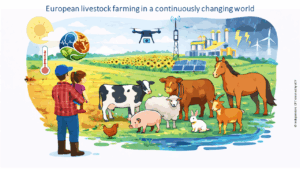
The symposium will be a mix of invited speakers and submitted papers.
This topic aims to address the consequences of several factors in building resilient livestock systems including land and water shortage, extreme heat for livestock farming and related operations, feed and food security/safety as well as lack of farmers to ensure future food production, social demands and how to minimise these impacts.
The theme also intends to explore the implications for the upstream and downstream sectors, such as animal feeding, breeding and medicines, food processors… involving all sectors including industry (milk processors, slaughterhouses, feed companies).
How can Europe’s livestock sector redefine its role and earn public trust while delivering sustainability and food security in an increasingly fragmented world?
(more info in the topic’s page)
Registration mandatory on the EAAP2026 website!
Provisional programme
Monday 07 September 2026
Sessions 03 (morning) and 16 (afternoon): European resilient livestock farming systems in a continuously changing world
| Time | Speech |
|---|---|
|
8:30 |
Welcome & introduction |
|
8:45 |
The New Era is now: Sustainable Livestock through global collaboration |
|
9:15 |
Navigating the future of animal protein in a changing global landscape |
|
9:45 |
Ensuring EU feed security and safety in a rapidly changing global environment |
|
10:15 |
Coffee break |
|
10:45 |
Exploring the Missing Middle: from polarization to systemic responsibility in Europe’s protein transition |
|
11:00 |
The social and economic challenges to farmers – how can generational renewal be achieved? |
|
11:15 |
EU Policy change related to the vision for agriculture and food, including simplification of EU rules and bureaucracy and comprehensive EU livestock strategy |
|
11:45 |
Panel discussion |
|
12:30 |
Lunch |
|
14:15 |
From concept to measurement: Advancing resilience analysis in small ruminant farming systems |
|
14:45 |
Using extended lactations to shape resilience of goat farming systems: a modelling approach |
|
15:00 |
The Aegean sheep breed revisited: phenotypic description and husbandry characteristics in island flocks of Greece |
|
15:15 |
Role of territorial stakeholders in the management of risks arising from interactions between wildlife and pastoral livestock systems |
|
15:30 |
Drivers of abandonment risk in autochthonous livestock systems: preliminary results from Castilla-La Mancha |
|
15:45 |
Coffee break |
|
16:15 |
Resilience of European livestock systems: multi-scale, context-specificity and methodological insights |
|
16:45 |
INOSYS “farm models”: a national living lab to simulate change and explore adaptation pathways in French livestock systems |
|
17:00 |
Intensive holm oak plantations as a climate adaptation strategy to enhance resilience of traditional Iberian pig production systems |
|
17:15 |
Multidimensional information system for zootechnics: the case study of buffalo farm and the dark side of outsourcing drivers |
|
17:30 |
Supply chain vulnerability in protein reduced poultry nutrition: a scenario approach to amino acid supply disruption in broiler production |
|
17:45 |
End of the symposium |