
Topic 2026
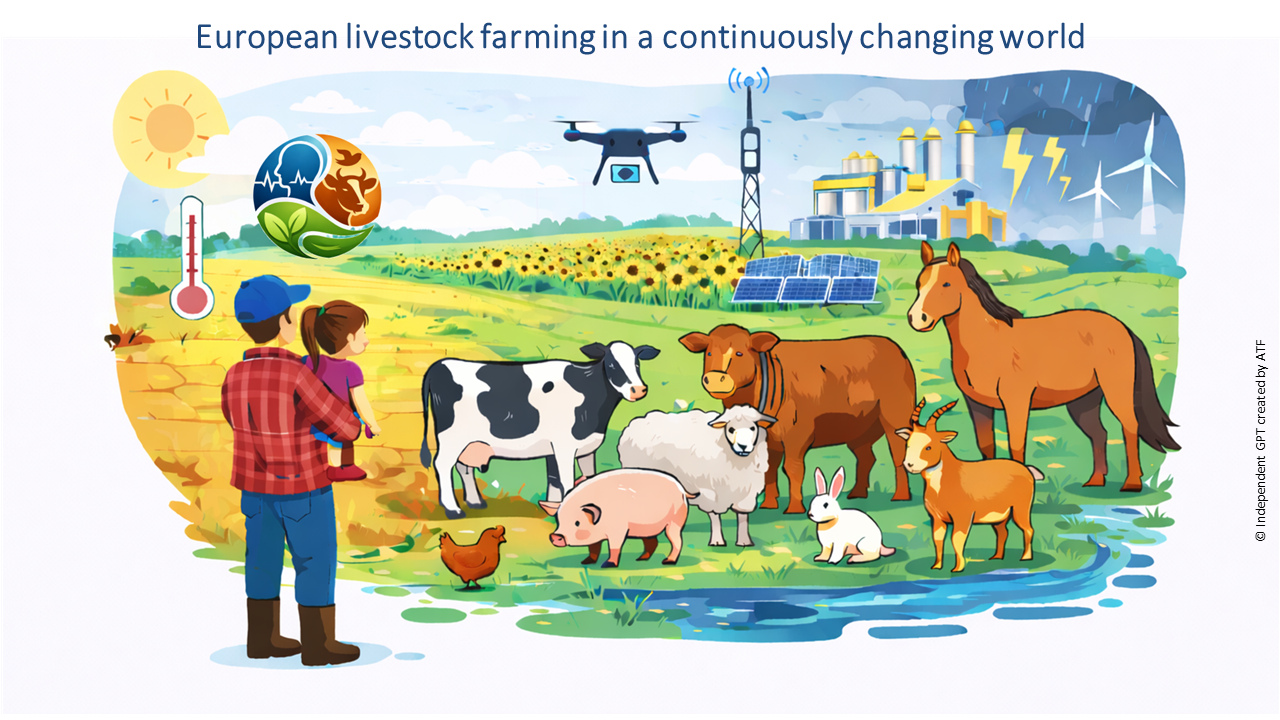
European livestock farming is going through a period of profound change. Geopolitical tensions such as the war in Ukraine and global trade disputes have disturbed feed supplies and reshaped market dynamics. At the same time, societal scrutiny over environmental impact, animal welfare and health is challenging the sector’s legitimacy – particularly in Western Europe.
Nevertheless, the livestock sector continues to play a vital role in Europe’s food and nutrition security. It contributes to circular food systems, supports rural economies and provides essential nutrients. As pressures mount, the sector must innovate and engage with policy and society to secure its place in a more sustainable and resilient food future.
How can Europe’s livestock sector redefine its role and earn public trust while delivering sustainability and food security in an increasingly fragmented world? Most of the focus on livestock and climate change has been on emissions of greenhouse gases and opportunities to mitigate them. However, the impact of climate change on livestock agriculture is becoming increasingly important as extreme weather events become more frequent; temperature rise is approaching the 1.5 degree set in the Paris Agreement, longer periods of drought or intense rain are increasingly frequent too. In addition, EU livestock production is challenged due to the global situation as such, as e.g. feed prices may be highly influenced by the price and/or availability of the raw materials. One example is the situation experienced in Ukraine with the limited exportation of barley/wheat, and a similar situation could be experienced with the USA in relation to the export of e.g. soy protein/corn.
This topic will address consequences of several factors in building resilient livestock systems, including land and water shortage, extreme heat for livestock farming and related operations, feed and food security/safety as well as lack of farmers to ensure future food production, social demands and how to minimise these impacts.
Water and land requirement and resilience of livestock farming to a changing environment such as fodder availability, feed additives supply, capacity to adapt and cope with emerging diseases and other critical situations are all-ready challenges faced by the farmers, and may be even further sharpen in the near future. The use of land and water in livestock production is under increasing scrutiny and the extreme weather events are dramatically affecting efficiency, livability and animal health, likely leading to displacements of some from farming areas and replaced by more resilient genetics and breeds. The uncertainty of climatic conditions is already dictating several changes in management practices, affecting more pronouncedly outdoor livestock systems (e.g. based on grazing areas), but also, and indirectly by influencing feed production (fodder and/or cereals, legumes, etc.), and putting systems sustainability at risk. The dramatic decrease and uncertainty on farmer generational renewal is a real problem and places future animal farming and livestock production in the EU in a difficult situation. This implicates higher food insecurity in the EU.
The theme also intends to explore the implications for the upstream and downstream sectors, such as animal feeding and nutrition, breeding and medicines, food processors, etc., involving all sectors including industry (milk processors, slaughterhouses, feed companies).
- Assessment methods (green, blue, gray water) to provide reliable information and to properly inform » policy makers » of the significance of the various calculations.
- Breeding to contribute to better use of water and animal resilience and adaptation to external factors such as heat stress.
- Housing and more adapted management practices, including animal feed resources (in particular: irrigation, new crops and industry by-products) and/or emerging animal health events.
- Exploration of new feed sources (green/blue/red biomass) and reduce feed/food competition.
- Conservation and better use of land and water in industry, including side-streams of food/feed production.
- How to address and ensure future farmers and the future of farms
Joint session of the ATF and EAAP Commissions on « Livestock Farming Systems » and « Sheep & Goat »
Monday 07 September 2026 – EAAP2026 – Hamburg, Germany (sessions 03 & 16)
Since 2013, the ATF-EAAP Special Session during the EAAP Annual Meeting aims to bring together animal science with practice of animal production and connect researchers, policymakers, industry representatives and societal organisations. Every year, a different topic is addressed during this session.
Once again, the EAAP Commission on « Livestock Farming Systems » and the ATF have worked together to organise a one-day symposium. This year, they have been joined by the EAAP Commission on « Sheep & Goat ».
Welcome & introduction, by Charlotte Lauridsen, ATF President & Joël Berard, EAAP President
- The New Era is now: Sustainable Livestock through global collaboration. By Badi Besbes, FAO-NSAP
- Navigating the future of animal protein in a changing global landscape. By Eva Gocsik, Rabobank
- Ensuring EU feed security and safety in a rapidly changing global environment. By Ruth Hayler, FEFANA and with inputs from FEFAC
- Exploring the Missing Middle: from polarization to systemic responsibility in Europe’s protein transition. By Michele Moretti, UNIPI
- The social and economic challenges to farmers – how can generational renewal be achieved? By Kirsten Wosnitza – German Farmer
- EU Policy change related to the vision for agriculture and food, including simplification of EU rules and bureaucracy and comprehensive EU livestock strategy. By Carlos Martin Óvilo, European Commission, DG AGRI – Unit E
- PANEL DISCUSSION – moderated by the session’s co-chairs, with speakers and audience
- From concept to measurement: Advancing resilience analysis in small ruminant farming systems. By Daniel Martín Collado, CITA Aragon
- Using extended lactations to shape resilience of goat farming systems: a modelling approach. By Carole Descheerder, Idele
- The Aegean sheep breed revisited: phenotypic description and husbandry characteristics in island flocks of Greece. By Maria Anastasia Karatzia, Ellinikos Georgikos Organismos
- Role of territorial stakeholders in the management of risks arising from interactions between wildlife and pastoral livestock systems. By Morgane Virapin, VetAgro Sup / University of Clermont Auvergne
- Drivers of abandonment risk in autochthonous livestock systems: preliminary results from Castilla-La Mancha. By Jennifer Claros-Zafra, Universidad de Córdoba
- Resilience of European livestock systems: multi-scale, context-specificity and methodological insights – By Francesco Accattino, INRAE
- INOSYS “farm models”: a national living lab to simulate change and explore adaptation pathways in French livestock systems. By Guillaume Mathieu, Idele
- Intensive holm oak plantations as a climate adaptation strategy to enhance resilience of traditional Iberian pig production systems. By Javier García-Gudiño, University of Extremadura / Centre of Scientific and Technological Research of Extremadura
- Multidimensional information system for zootechnics: the case study of buffalo farm and the dark side of outsourcing drivers. By Domenico Vecchio, IZSM
- Supply chain vulnerability in protein reduced poultry nutrition: a scenario approach to amino acid supply disruption in broiler production. By Julia Gickel, University of Veterinary Medicine Hannover
Wednesday 25 November 2026 – Brussels, Belgium + online
Coming in November…